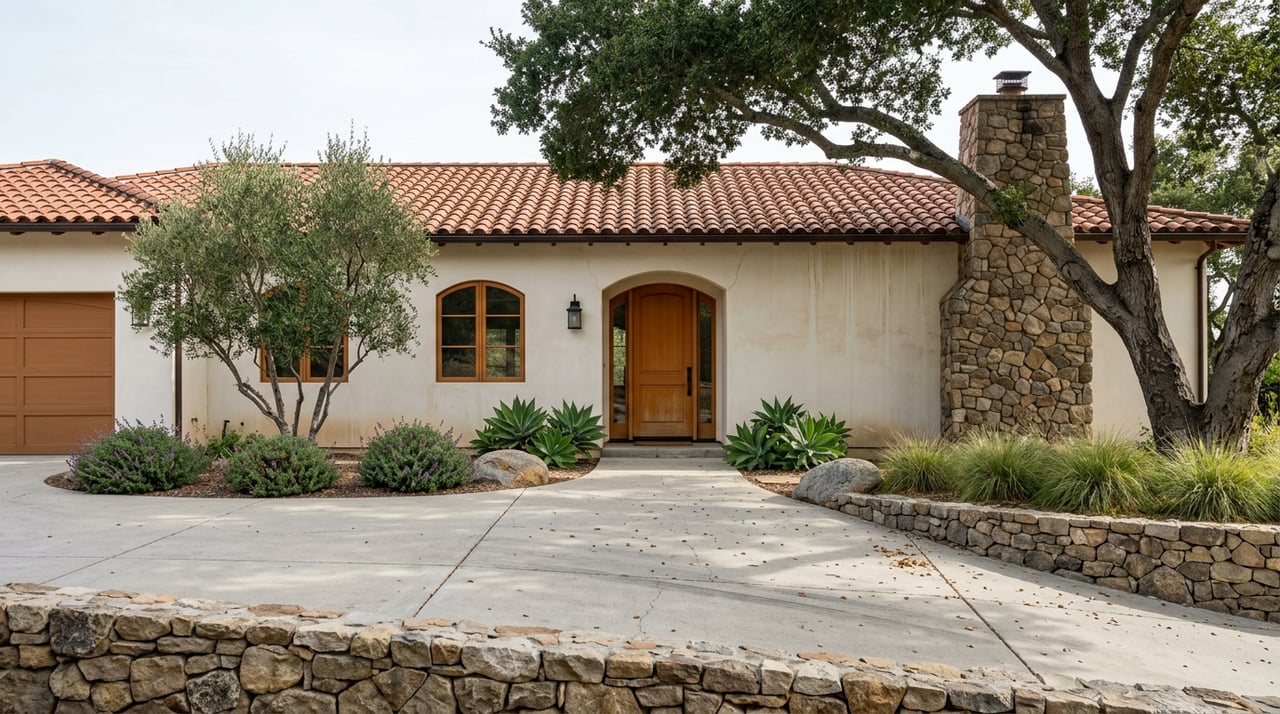
Two three-bedroom homes list for $1,150,000 this month in Brea. One sits in Eagle Hills, an older single-family tract on the west side of town. The other sits in a hillside Blackstone phase built by Shea Homes. Same price. Same lender. Same 30-year fixed rate. A buyer who compares only the two listing sheets will assume the monthly payment lands in the same place for both.
It doesn't. And the gap isn't a rounding error. It's a structural difference in how the two homes are taxed, one that the citywide median price is built to hide rather than reveal.
One Median, Two Tax Systems
Brea's median home price sat at $1,150,000 as of August 2026, with the average sale price running slightly above that at $1,168,104 across 47 active single-family listings. That number gets quoted constantly, and it's accurate. What it doesn't tell you is that the homes making up that median sit under two entirely different property tax regimes, and which one applies to a given address has nothing to do with its price.
The split traces back to 1978, when California voters passed Proposition 13 and capped the base property tax rate at 1% of assessed value, with annual increases limited to 2%. That protected homeowners from runaway tax bills, but it also cut off the funding mechanism cities and developers had used to pay for the roads, sewers, and parks that new subdivisions need. Four years later, the state answered with the Mello-Roos Community Facilities Act of 1982, authored by Senator Henry Mello and Assemblyman Mike Roos. It let local governments form Community Facilities Districts, or CFDs, that issue bonds for that infrastructure and repay them through a special tax layered on top of the base 1%.
Older Brea neighborhoods built before that financing tool became standard practice, tracts like Eagle Hills and Olinda Village, generally sit outside any CFD. Their owners pay something close to the Orange County baseline, which runs roughly 1.1% to 1.2% of assessed value in a typical year. Newer master-planned communities built the infrastructure-bond way instead. In Brea, that means specific phases inside Blackstone and La Floresta.
Which Brea Addresses Actually Carry It
This isn't a citywide tax. It's parcel-specific, and it maps onto construction era more than it maps onto price.
Across Blackstone and La Floresta, builder phases such as Shea Homes' Emerald Heights and Coral Ridge, Standard Pacific's Paseo and Avenida, and Van Daele's Ventanas were built with CFD financing attached to specific parcels. As of early 2026, current builders still active on remaining Brea inventory include Toll Brothers, William Lyon, Shea Homes, and TRI Pointe, and CFD assessments in newer Brea master-planned phases typically run $150 to $400 a month or more on top of the base rate, depending on the bond schedule for that specific tract.
Compare that to Eagle Hills, where a resale listing at the same $1,150,000 price point carries none of that. The buyer there is paying the base rate and nothing else tied to infrastructure bonds.
| Community type | Example | CFD/Mello-Roos | Base tax rate impact |
|---|---|---|---|
| Older single-family tract | Eagle Hills, Olinda Village | None | Close to base 1.1%-1.2% |
| Hillside master plan | Blackstone (Shea Homes phases) | Yes, on affected parcels | Adds $150-$400+/mo |
| Attached/PUD new construction | La Floresta, Downtown-area builds | Yes, plus separate HOA | Adds CFD cost and monthly HOA |
That last row matters because CFD and HOA are two different bills that often get lumped together in a buyer's head. They shouldn't be.
The Bond Clock Nobody Puts On The Listing Sheet
Here's the detail that even careful buyers tend to miss. A CFD bond doesn't run forever. It has a term, typically 20 to 30 years from the date the district issued the bonds, and the special tax disappears once that bond is paid off. That means two homes in the same CFD-taxed pocket of Brea can be at genuinely different points in that payoff clock.
A resale in one of Blackstone's earlier Shea Homes phases from the 2010s may have fewer years of CFD payments left than a home in a newer phase that broke ground more recently and just started its own 25-to-30-year bond term. The listing sheet won't show you which is which. The property's recorded CFD documents and current tax bill will, because they show the original bond issuance date and the outstanding term.
This is the kind of detail that never shows up in a median price comparison but changes the real math for a buyer planning to hold the property for ten or fifteen years versus a buyer planning a shorter stay.
Why The Median Never Shows Any Of This
Brea's market has been moving in a fairly narrow band through 2026. Redfin tracked a median sale price of $1.2 million over the three months ending in May 2026, up 10.6% from the same period a year earlier, with homes taking an average of 29 days to sell compared to 21 days the year before. PropertyShark's first-quarter figures put the median at $1.1 million with a median price per square foot of $591, on 60 transactions, down 31% from the same quarter a year prior.
Those numbers describe price and pace. They say nothing about the tax structure sitting underneath any individual sale, because a median is built by throwing every transaction into one pool and taking the midpoint. A CFD-taxed home in Blackstone and a CFD-free resale in Eagle Hills both count as one data point each, at whatever price they closed. The median treats them as interchangeable. Your mortgage lender will not.
When a lender calculates your debt-to-income ratio, a CFD special tax gets added into your monthly housing cost right alongside the mortgage payment, property tax, and any HOA dues. A $300-a-month CFD assessment functions, for underwriting purposes, almost exactly like $300 more in mortgage payment. Two buyers qualifying for identically priced Brea homes can end up with different maximum loan amounts depending on which parcel they're trying to buy, simply because one carries this extra monthly obligation and the other doesn't.
The HOA Is A Separate Line, Not The Same One
It's worth separating these two costs clearly, because they get bundled together in casual conversation and they shouldn't be. HOA dues fund ongoing maintenance of shared amenities, landscaping, and common areas, and they apply based on product type. Attached homes and planned unit developments in La Floresta and other newer Brea communities typically carry monthly HOA dues in the $200 to $450 range. Eagle Hills, being an older detached single-family tract, generally has low or no HOA at all.
CFD taxes fund the original infrastructure bond and show up on the county property tax bill rather than as a separate HOA invoice. A home can carry one, both, or neither, and the only way to know for certain is to look at the actual documents rather than assume based on the neighborhood's general reputation.
Before You Write An Offer
- Pull the most recent secured property tax bill for the specific parcel, not just a comparable one down the street
- Ask your agent or the listing agent for the Notice of Special Tax if the home is in a CFD, which discloses the bond term and remaining years
- Check the Orange County Treasurer-Tax Collector's site directly for the parcel's current-year tax detail before writing an offer
- Confirm whether HOA dues apply separately from any CFD tax, since they fund different things and neither one substitutes for the other
- Ask your lender to run the payment with the actual CFD and HOA figures included, not an estimate based on the base rate alone
A Few Direct Questions
Does the Mello-Roos tax go away eventually? Yes, once the underlying bond is paid off, which is typically 20 to 30 years from issuance. The remaining term is disclosed in the property's recorded CFD documents.
Is a Mello-Roos payment tax deductible like regular property tax? Some portion may be deductible if it funds ongoing services rather than new construction, but the rules are specific enough that this is a question for a tax professional reviewing your actual CFD documents, not something to assume either way.
Does every new Brea community have a CFD? No. Not every parcel in Blackstone or La Floresta carries one, and terms vary by phase and builder. The only way to know for a specific address is to check the recorded documents for that parcel.
The median price gets you in the door. It won't tell you what you're actually agreeing to pay every month for the next two or three decades. That's a conversation worth having with someone who's watched these specific Brea tracts get built out phase by phase, not just someone reading the same listing sheet you are.
If you're comparing homes across Brea's older tracts and newer master plans and want the real monthly cost worked out before you write an offer, The Kennedys can walk the tax documents with you. Start with a Free Home Valuation if you're on the selling side of that same math.