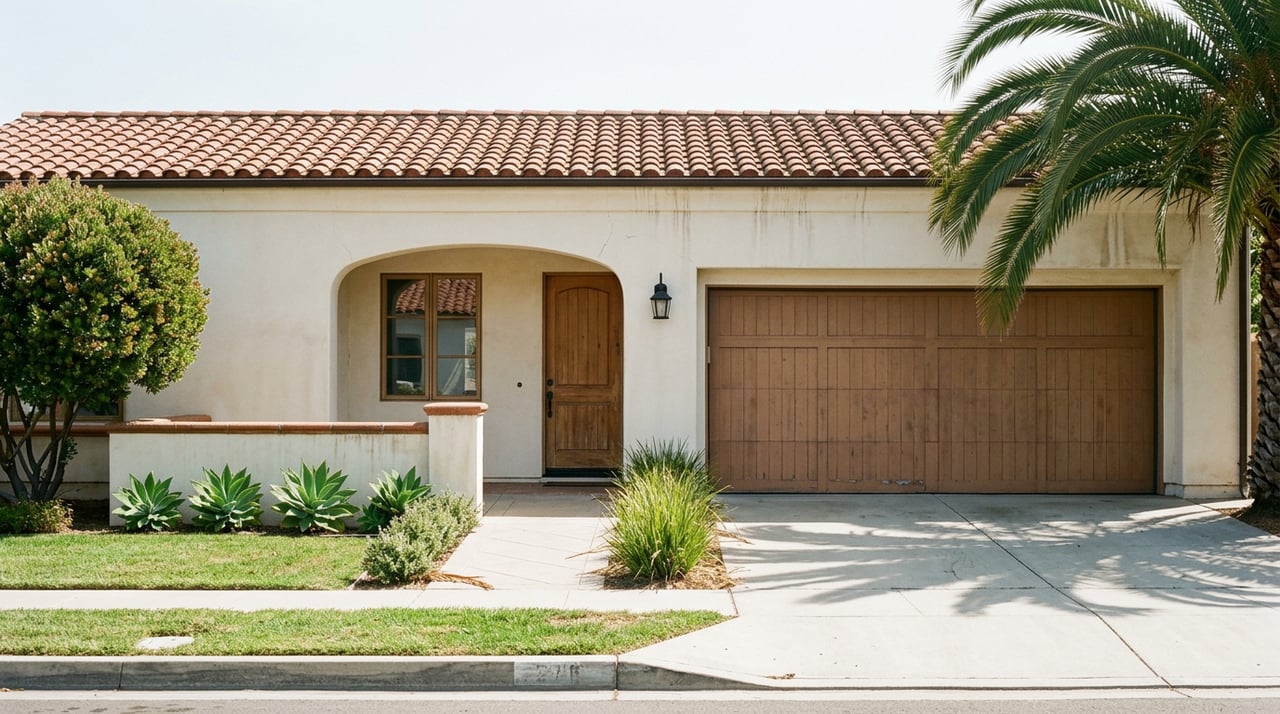
A homeowner on Whiting Avenue wants to swap out a window. A homeowner two streets over, in a house built the same decade, wants to do the same thing. One of them needs a design review before a contractor can touch the frame. The other doesn't. Both houses are inside a city-recognized historic district. Both show up on walking tours and in Fullerton Heritage's own survey of the city's older housing stock. The difference between them has nothing to do with age, architecture, or how the house looks from the sidewalk. It comes down to a zoning classification most buyers never think to ask about, and most listings never mention.
Fullerton has identified 16 residential historic districts. Only 10 of them carry a Residential Preservation Zone designation, the overlay that actually triggers mandatory design review under the city's Municipal Code. The other six are historic in name and in the city's own survey work, but they don't sit inside a zone that requires staff sign-off before you repaint a facade, replace a window, or add a second story. If you're buying, selling, or planning a renovation inside one of Fullerton's older neighborhoods, that distinction is worth more than the word "historic" on the listing sheet.
What a Preservation Zone Actually Does
The zone classifications are R-1P, R-2P, and R-3P, single and multi-family residential preservation zones written into Chapter 15.17 of the Fullerton Municipal Code. A preservation zone only gets applied when a majority of property owners in a district petition for it and the City Council approves. Fullerton Heritage, the city's nonprofit preservation group, has worked alongside city staff on nearly every one of these petitions over the past three decades.
Once a district has that designation, a specific set of design guidelines applies to any exterior work. The guidelines were adopted by the City Council through Ordinance 2886 in March 1996, and they get specific. Porte cocheres, for instance, are supposed to stay open. The guidelines direct that an existing porte cochere should be preserved as an architectural feature and not enclosed with fences or gates, the kind of detail a homeowner might not think twice about until a permit reviewer flags it. Additions are supposed to go in side or rear yards, out of view from the street, rather than tacked onto the front. One example the city's own guidelines point to, a second-story addition on the 1100 block of West Whiting Avenue, gets cited as a model for how new construction can match the scale and rhythm of the original block face.
None of that applies automatically just because a house is old. It applies because the house sits inside one of the 10 zoned districts.
One specific carve-out worth knowing if you're looking at a rural-feeling lot on the east side of the city: the Pico-Carhart Rural Street Design Guidelines cover a defined set of streets, Pico Street, Carhart Avenue, Johnson Place, Stephens Avenue, Beverly Drive, Rose Drive, Ramona Drive, Arroyo Drive, and portions of Fern Drive and Valley View Drive. If your search includes any of those addresses, the renovation rules aren't generic citywide zoning. They're written for that specific stretch of road.
Two Neighborhoods Are Petitioning Right Now
This isn't settled history. As of this writing, the city's Planning Division lists two neighborhoods actively working through the preservation zone process: Lower Golden Hill and Oceanview, and separately, Skyline Park. Both have expressed interest to the city, and both processes require the same thing every prior zone required, a majority of property owners petitioning and a City Council vote.
If you're weighing a purchase in either area, or already own there, the design review rules on your street could look different a year from now than they do today. A homeowner who finishes an addition before a zone vote and a homeowner who waits until after could face two different review processes for what is functionally the same project. That's not a hypothetical. It's the same path all 10 existing preservation zones already walked.
The Mills Act Changes the Math, Not Just the Rules
Design review is the regulatory side of owning in a historic district. The Mills Act is the financial side, and it's the piece that actually shows up in a seller's net proceeds or a buyer's monthly carrying cost.
The Mills Act is a California program, established under Government Code Article 12, that lets a city enter into a property tax reduction contract with the owner of a qualified historic property. Fullerton participates, and its version of the program has specific numbers attached.
| Mills Act detail in Fullerton | Figure |
|---|---|
| Application processing fee | $1,520 |
| Annual processing fee after approval | $85 |
| Maximum assessed valuation to qualify | Under $800,000 |
| Inspection frequency | Every five years, owner must be present |
| Rehabilitation plan renewal | Due at least 90 days before the end of each 10-year term |
The $800,000 assessed valuation cap is the detail that catches people off guard. Assessed value in California, thanks to Prop 13, is often far below current market value, especially on a home that's been in the same family for decades. A Craftsman bungalow that would sell for well over a million dollars today might still carry an assessed value under that $800,000 threshold if it hasn't changed hands recently, which means it could still qualify even though the market price suggests otherwise. The reverse is true too. A property that traded hands recently and got reassessed closer to market value may already be priced out of the program before a buyer even looks at it.
Under a Mills Act contract, the property's tax value is calculated using an income approach rather than a straight market comparison, treating the home as if it generated rental income and taxing it on that basis instead of on what it would fetch in a sale. That's usually lower than a standard assessment, which is the entire point of the program.
Here's the part that matters most at the closing table: Mills Act contracts transfer with the property. A buyer doesn't get to opt out of the maintenance obligations, and a seller doesn't get to keep the tax benefit after the sale. Whatever restoration and upkeep commitments the current owner signed up for become the new owner's responsibility the day escrow closes. For a seller, an active Mills Act contract can be a genuine selling point, lower carrying costs are real money to a buyer doing the math on a historic property. For a buyer, it's worth reading the actual contract terms before assuming the tax savings are unconditional.
Before You List or Write an Offer
A few things worth confirming early, whether you're the one selling a historic Fullerton property or the one about to make an offer on one:
- Call the city's Planning Division at (714) 738-6559 and ask directly whether the address sits inside one of the 10 zoned historic districts, one of the six unzoned ones, or the Pico-Carhart rural street area specifically.
- Ask whether a Mills Act contract is already recorded against the property, and if so, how many years remain on the current 10-year term.
- If the property is in Lower Golden Hill, Oceanview, or Skyline Park, ask the city whether the preservation zone petition has moved to a Council vote yet. That answer could change what a buyer is allowed to do with the house six months from now.
- For any exterior project, confirm whether it needs design review before pulling permits. A porch enclosure, a window swap, or a second-story addition can mean very different timelines depending on which side of that zone line the house falls on.
A Few Direct Questions
Does every old house in Fullerton need city approval before I repaint it? No. Design review under the residential preservation zone guidelines only applies to the 10 zoned districts, and even there, the guidelines focus mainly on changes visible from the street rather than every cosmetic choice.
If I buy a home with a Mills Act contract, do I inherit the tax savings or the restrictions? Both. The contract transfers with the property, meaning the reduced assessment continues, but so does the obligation to maintain and restore the home according to the plan on file, along with the five-year inspection cycle.
How do I find out if my address is one of Fullerton's 16 historic districts? The Planning Division can confirm district status by address, and Fullerton Heritage maintains its own survey of the city's historic and landmark properties for reference.
Historic district status in Fullerton isn't a single label. It's a layered set of decisions, some made in 1996, some being made this year, that change what a specific address is allowed to do and what it's worth doing. If you're weighing a purchase or a sale inside one of these neighborhoods, Christine Kennedy and the team can walk through what applies to your specific address before you write an offer or list a home. Get a Free Home Valuation and we'll start with exactly that question.